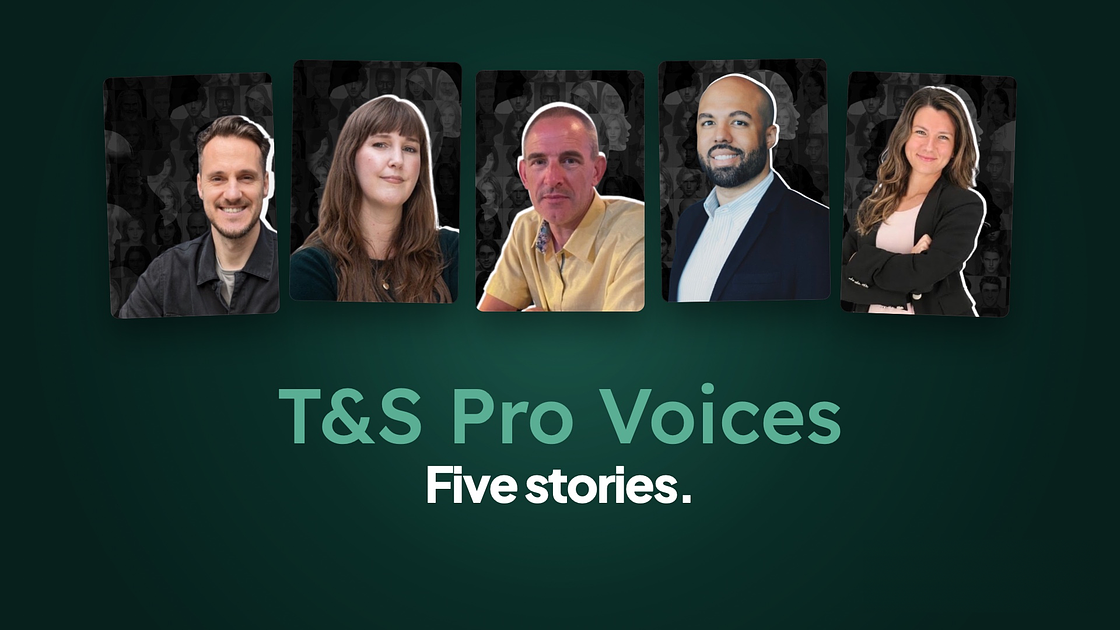
T&S Pro Voices so far. Five stories.
Five stories in, it felt like a good time to look back at what our guests have told us so far, and to merge the interviews into one bigger picture
Why we started T&S Pro Voices
When we announced T&S Pro Voices, we wanted to hear from the people who keep online communities safe, not just read about the platforms they work for. Most of their work happens out of sight, and so do their stories.
It started with a LinkedIn poll. Over 88% of the people who voted said they'd read a series like this, and 2 out of 3 said they were very curious about it, so we went for it.
Each interview was done separately, and each story stands on its own. But reading them back one after another, we kept spotting some patterns in their stories. We also found a couple of places where our guests clearly see things differently.
The five voices
- Tiago Lopes: From policy enforcement to T&S leadership
- Alice Hunsberger: On AI, inclusion and where T&S goes next
- Andrew Briercliffe: Identifying victims, demanding honesty
- Jerrel Peterson: Leading with values and looking beyond the obvious
- Debora Maistrello: Building Trust and Safety from scratch
Tiago studied Environmental Engineering. Alice edited documentaries. Andrew worked in UK law enforcement, Jerrel was a social worker and Debora started out in Customer Support. Not one of them set out to work in Trust and Safety. Alice took a part-time moderation job at OkCupid during the 2009 recession. Jerrel was laid off and a friend suggested he try tech. Andrew was asked if he'd help set up a new unit, and says he came into this work "a little by accident." Tiago has made peace with his own route: "While I may have entered the field by chance, I like to think it was meant to be."
Their first careers came along for the ride. Alice describes the thread from editing to policy as "organizing chaos, building frameworks, drawing lines." Jerrel felt like an imposter at Twitter for his first few months, "but over time I realized my social work training and advocacy skills were incredibly useful." Debora says Customer Support gave her "a solid foundation in active listening, triage, and handling urgent, high-severity escalation workflows under pressure." If you wonder whether your background counts, their answer is yes.

T&S: The work nobody sees
Debora calls T&S "an invisible function: when everything goes right, nobody notices." When it goes wrong, everyone does, and fast. Jerrel says its success is "often invisible to other stakeholders within the business." Alice has lived the consequences. Across 13 years at two dating platforms she watched T&S swing between central to the product and a cost centre. "The work and the team didn't change: the priorities at the top did."
Andrew's fix is honesty. He'd take a platform saying "we tried such and such and it didn't work" over another good-news announcement, and thinks users "might have a bit more faith." Jerrel's proudest project, Twitter's first public comment period on a new policy, worked that way: users gave feedback, and the team went back and showed them how it had changed the rules. It cemented for him "the value of cross-functional collaboration, transparency, and empowering users to be part of the processes that impact them." Debora wants T&S people to talk more openly about their day-to-day work, "making the invisible visible," and admits she's still learning to do that herself.
Three guests also argued, unprompted, that every platform needs T&S. Tiago: "Ideally, any platform that allows user interaction, whether social media, e-commerce, gaming, services, or dating, should have a Trust and Safety team, even if it's small." He sees the real gap in the many companies that don't realise they need one. Andrew goes wider: "Any company that has an online presence needs in some way, T&S."
Debora sees that gap every day. In Italy, "'safety' is still mostly associated with physical workplace safety rather than digital protection." Dedicated T&S roles are rare, so Italian professionals compete for a small number of international jobs. She doesn't want to rename the field to make it an easier sell: "I don't think the answer is to rename Trust & Safety to fit local habits but to educate the market that this function exists." Her story made us wonder how many other markets are in the same position.
AI, burnout and the human in the loop
Alice is the most excited about AI of anyone we spoke to. She's been hands-on since red-teaming for OpenAI in 2022, and she hopes "the days of 'paying your dues' by slogging through endless traumatic content day after day like a robot are over." Debora is more measured: "Low-severity issues like spam, scams, and phishing can largely be automated through machine learning. But keeping a human in the loop remains essential for edge cases, anomalies, and spikes."
Andrew and Tiago look at the people instead. For Andrew, the technology is rarely the problem; it's how people choose to use it. Tiago worries that as T&S expands into AI governance and tooling, the human elements "often don't receive the same level of attention as systems or metrics." Nobody we interviewed expects AI to replace T&S teams.
Tiago talked about burnout more than anyone. He wants a field where "talented people can commit for decades, not just survive a few intense years," which is why he started The Manual Break. Jerrel's advice to newcomers fits on a card, and he adds that you should make time for whatever keeps you going outside work.

Where they disagree: what should we call ourselves?
We went in curious about one question: should the industry standardise its team names and structures? It was the one topic where our guests split. Andrew says the mix of job titles "causes all sorts of confusion, even during recruitment," and thinks the industry could fix it. Tiago is more hopeful: "Big tech companies have made great progress in standardizing job roles and responsibilities, but smaller companies still use inconsistent terminology."
Alice disagrees. The naming chaos, she says, "actually reflects real structural differences in how companies organize this work." She expects T&S to merge more and more with AI safety, security and governance, and thinks that's a good thing.
Debora works in a market where hardly anyone uses the term, so for her the name matters less than getting companies to see that the function exists. Jerrel's interview didn't cover the question. That's four views from four guests, and we doubt it gets settled soon.
More stories, one voice
It has been great to see how professionals from different countries, backgrounds and teams share so much of the same T&S experience: the invisible work, the unplanned paths in, the worry about burnout. This gives us an extra push to keep interviewing T&S professionals at every level, so we can build a voice that shows what the work really feels like from the ground.
If you work in Trust and Safety and have a story to tell, we'd love to hear it, whatever your role, background or country. Apply to be featured.
You can read all five stories on the T&S Pro Voices page.